Mission Control - your 24/7 travel agent that watches your flights, rebooks when rates drop, and turns booking into a conversation.
Moonshot Travel doesn't open with a search form. It opens with a conversation. Mission Control is the conversational interface to every flight, every fare, every trip.
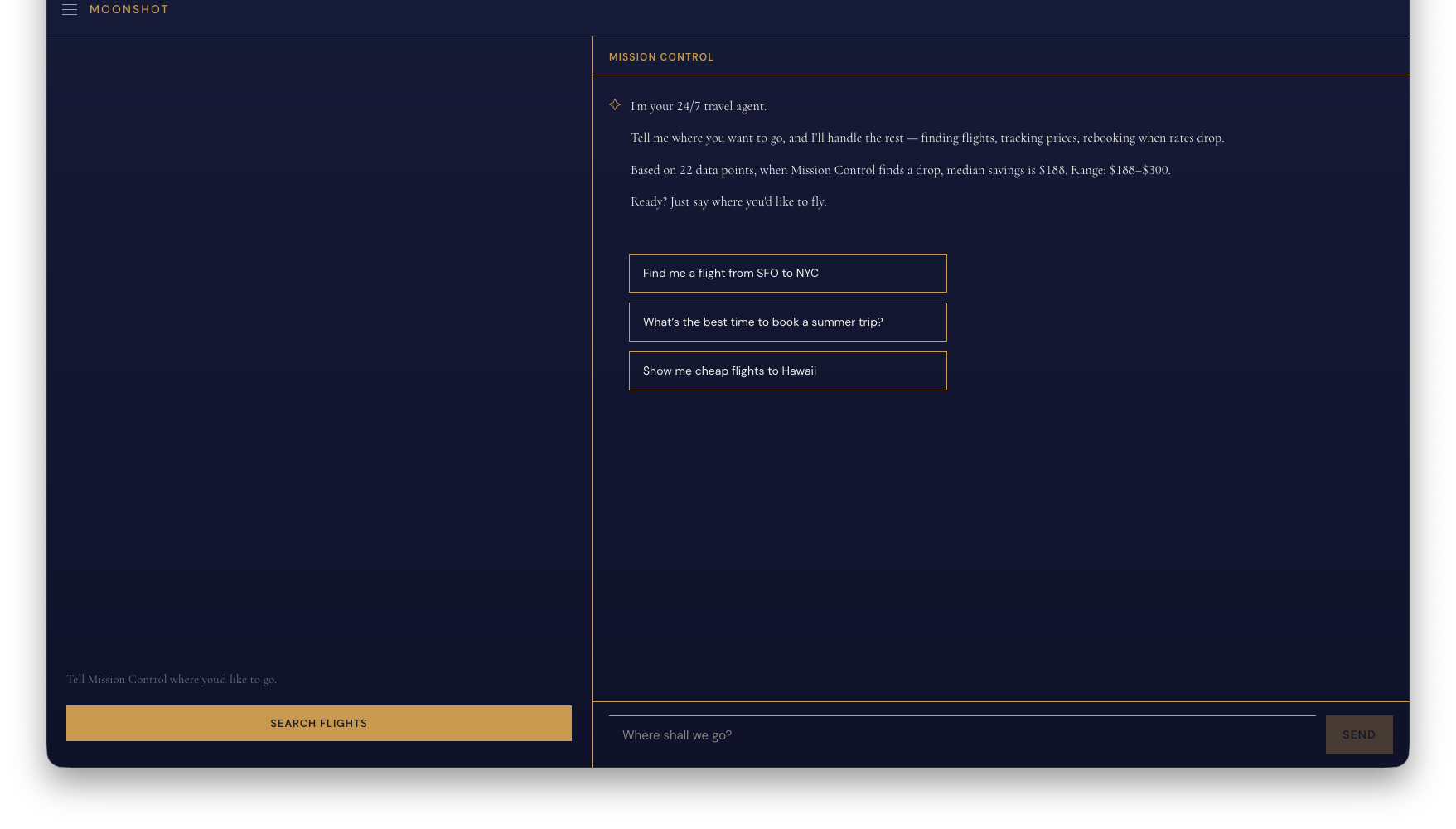
Mission Control is your 24/7 travel agent. Tell it where you want to go, and it handles the rest - finding flights, tracking prices, rebooking when rates drop.
A single text input. No fields, no date pickers, no origin/destination dropdowns. Just type where you want to fly.

"Based on 22 data points, when Mission Control finds a drop, median savings is $188. Range: $188-$300." Not a marketing number - a real number with a real sample size.
Three tappable prompts sit under the agent's greeting. For users who freeze at a blank input, these are the on-ramp.
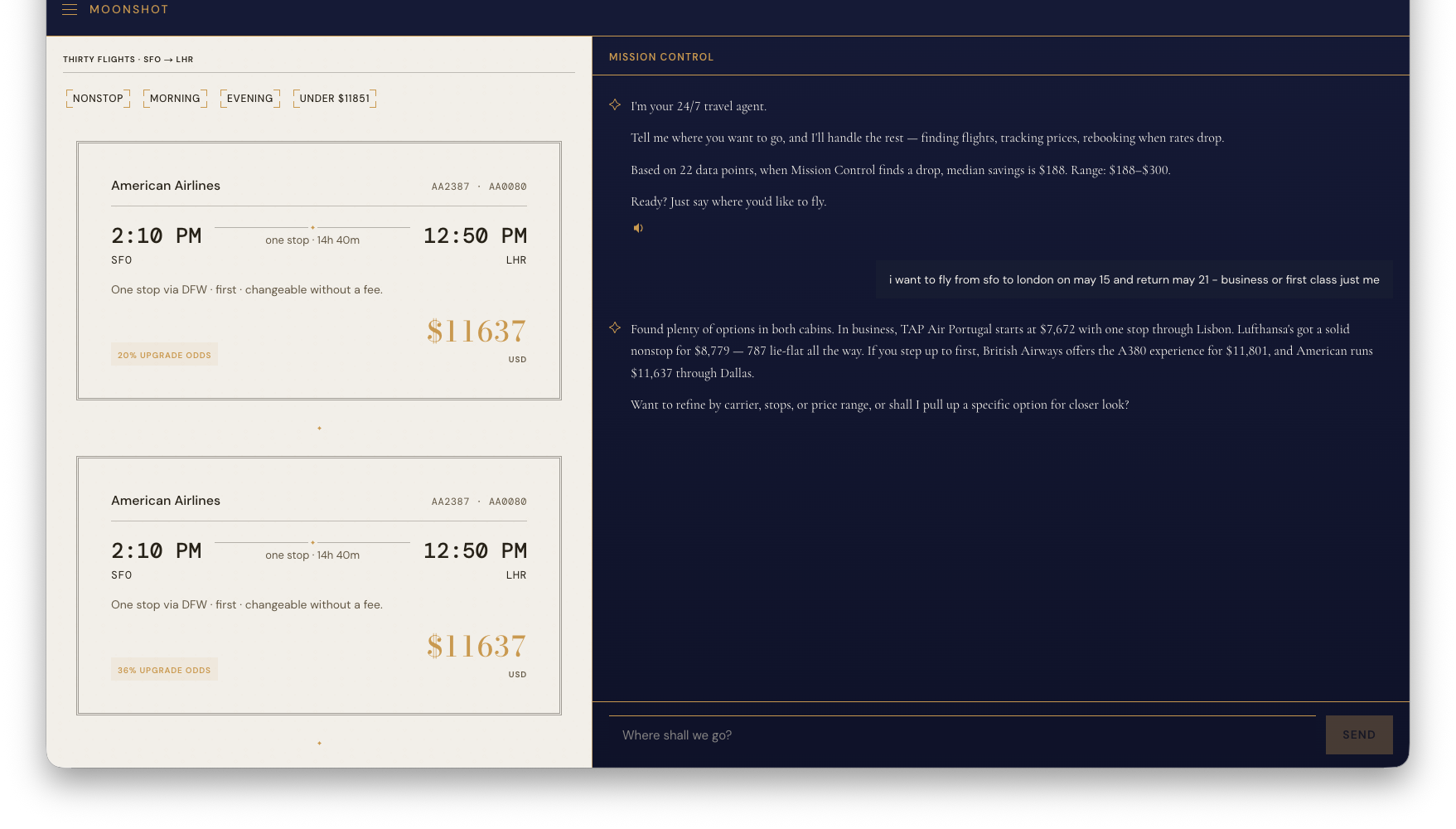
When Mission Control finds your flights, the left rail fills with cards and the right rail keeps talking. Four filter chips cut the list without leaving the conversation.

Results are a conversation, not a spreadsheet. Mission Control summarizes what it found in plain English, flight cards make those words real, chips narrow without retyping.
Airline, flight numbers, times in airline-display format, route via airports, fare class, flexibility, price right-aligned in USD. American Airlines AA1860/AA0194, 12:21 PM SFO to 10:50 AM LHR, $9,702.

NONSTOP. MORNING. EVENING. UNDER price ceiling. No checkboxes. No sliders. Four taps cover 90% of what real travelers narrow on.
"THIRTY FLIGHTS - SFO → LHR" sits above the results. Number, route, monospace. A signature that says "we counted, you don't need to."
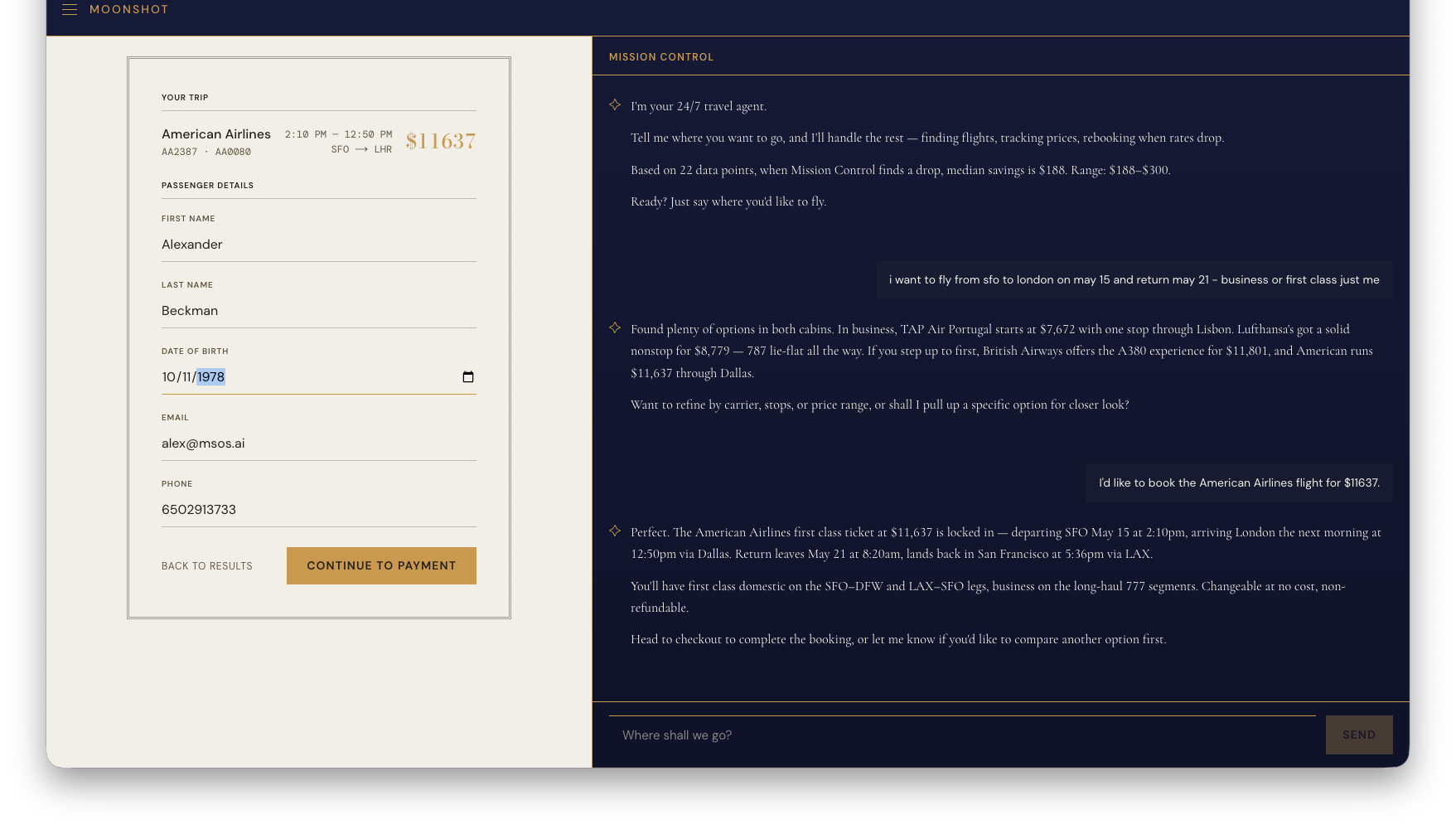
Selected state. The card expands. A single "BOOK THIS FLIGHT" button. Stripe + Duffel Balance pre-funded.

Booking is the moment of truth. One tap, one Stripe sheet. Every additional friction step is a percentage of users we lose at the most expensive moment.
Tap a flight card and a blue ring lights its border. Card expands with flexibility line and a single full-width button: BOOK THIS FLIGHT.

User pays Stripe directly. Apple Pay and Google Pay one-tap. Stripe handles SCA, 3DS, fraud screening.
Webhook hits backend, backend calls Duffel API to create the order from pre-funded Duffel Balance, PNR returns. Stripe -> us -> Duffel.
Most travel sites end at booking. We start there. Three products turn one ticket into a system that watches fares, captures drops, and books savings automatically.
The thesis: airfare is a market that moves after you buy. Most travelers eat the loss because nobody watches their fare after booking. Moonshot does.
Same flight, same seat, same airline. If the price drops after you book, we rebook you onto the identical flight at the lower fare and refund the difference.
Same airline, any flight within travel window. Status miles still earn. Loyalty stays intact.
Any airline, refundable base. We watch the entire market for your route. Maximum savings, minimum loyalty constraint.
My Trips is where the watch begins. Booked ticket, watched fare, savings ledger.
My Trips is the proof of work. The user sees their booking, the fare we're watching, alerts as the price moves, and money saved.
Each booked trip gets a card: route, dates, airline, PNR, current fare watch status, "savings to date."
Per-trip dollar savings, lifetime running total. The ledger is the screenshot. Every user with a positive ledger is a referral source.
When Mission Control catches a drop and rebooks, the user gets a notification ("we just saved you $247"), trip card updates.
Every Mission Control search is a price observation. Every rebook is a confirmed pricing event. The densest airfare time-series outside of GDS providers.
The dataset-as-moat thesis is locked. Every architectural choice optimizes for data integrity. Three products generate three signal types per user.
Every search returns 30+ flights with fare, fare class, restrictions, timestamp. Multiplied across thousands of searches per day.
Most price data is "what airlines said." Booking data is "what people actually paid." We have both - paired together with decision.
Every successful rebook is the dataset confirming its own prediction. Ground truth label on the "this is a high price" signal.
Consumer activity generates the corpus. Underneath, Moonshot Intelligence - paid feed for corporate travel, hedge funds, insurers, airlines.
Three paths to fares: Duffel today, Verteil aggregator next, airline-direct NDC after. Each unlocks more inventory and bigger margin per ticket.
Supply is the cost ceiling and the margin floor. Today thin spread on Duffel. Verteil unlocks 85+ airlines. Airline-direct earns full distribution margin.
Live now. Duffel aggregates content via NDC and GDS, clean REST API, transparent per-PNR fee. Best-in-class developer experience.
Aggregator at next price tier (~$1-5K/mo). 85+ airline direct connections. Better margin per ticket.
The endgame. Direct NDC to specific carriers. Requires IATA TIDS or Accreditation, ARC for US. $25-75K per carrier. Full margin retained.
Two-repo architecture: Vercel for web frontend, Replit Autoscale for backend, Neon for Postgres, Clerk for auth, Duffel for supply, Stripe for payments.
Next.js on Vercel at msos.ai. Repo github.com/alexbeckman83/moonshot-web. Server components for SEO, client for Mission Control. Clerk at clerk.msos.ai.
Node + Express on Replit Autoscale. Repo github.com/alexbeckman83/moonshot-travel. Neon: ep-noisy-firefly-aeckrzmj.
Duffel API for inventory. Stripe Checkout for payment. Stripe webhook -> backend -> Duffel order. Flag DUFFEL_USE_PAYMENTS=false gates old path.
Total ~$50-150/mo at pre-launch / early-launch scale.